Physical Address
304 North Cardinal St.
Dorchester Center, MA 02124
Physical Address
304 North Cardinal St.
Dorchester Center, MA 02124

If you have a large yard, you have likely been burned by the robot mower promises before. Ineffective on slopes, confused by complex layouts, or neutered by a buried perimeter wire that breaks every spring. You are looking at a machine that costs as much as a used car, so you need to know if it actually delivers or if it is just another expensive disappointment. Our YARBO robot lawn mower review is the result of four weeks of real-world testing on a 3-acre property with steep grades, mixed grass types, and no buried wire. We are not here to sell it to you. We are here to report what we found, what worked, what did not, and whether the price ever makes sense.
Disclosure: This review contains affiliate links. Purchasing through them supports our work at no added cost to you. All testing was conducted independently.
If you are comparing this to other heavy outdoor gear, see our detailed YARBO robot lawn mower pro review for the full breakdown of the modular attachments.
The Yarbo M1 is a premium, heavy-duty robotic mower that sits at the very top of the consumer market, both in ambition and price. It is manufactured by Yarbo International Inc., a company that has focused on modular outdoor robotics from the ground up. This is not a toy or a gadget. It is a nearly 240-pound machine built to replace a zero-turn rider on properties that are too large or too steep for a typical robot mower. Its specific engineering feat is combining RTK satellite positioning with AI vision to navigate without a perimeter wire, a capability that immediately separates it from the vast majority of competitors that still rely on burying a wire loop around your entire property. It is not a quick weekend project. If you are looking for something to maintain a small postage-stamp lawn, this is the wrong machine. Our YARBO lawn mower review and rating will clarify exactly where this investment makes sense.
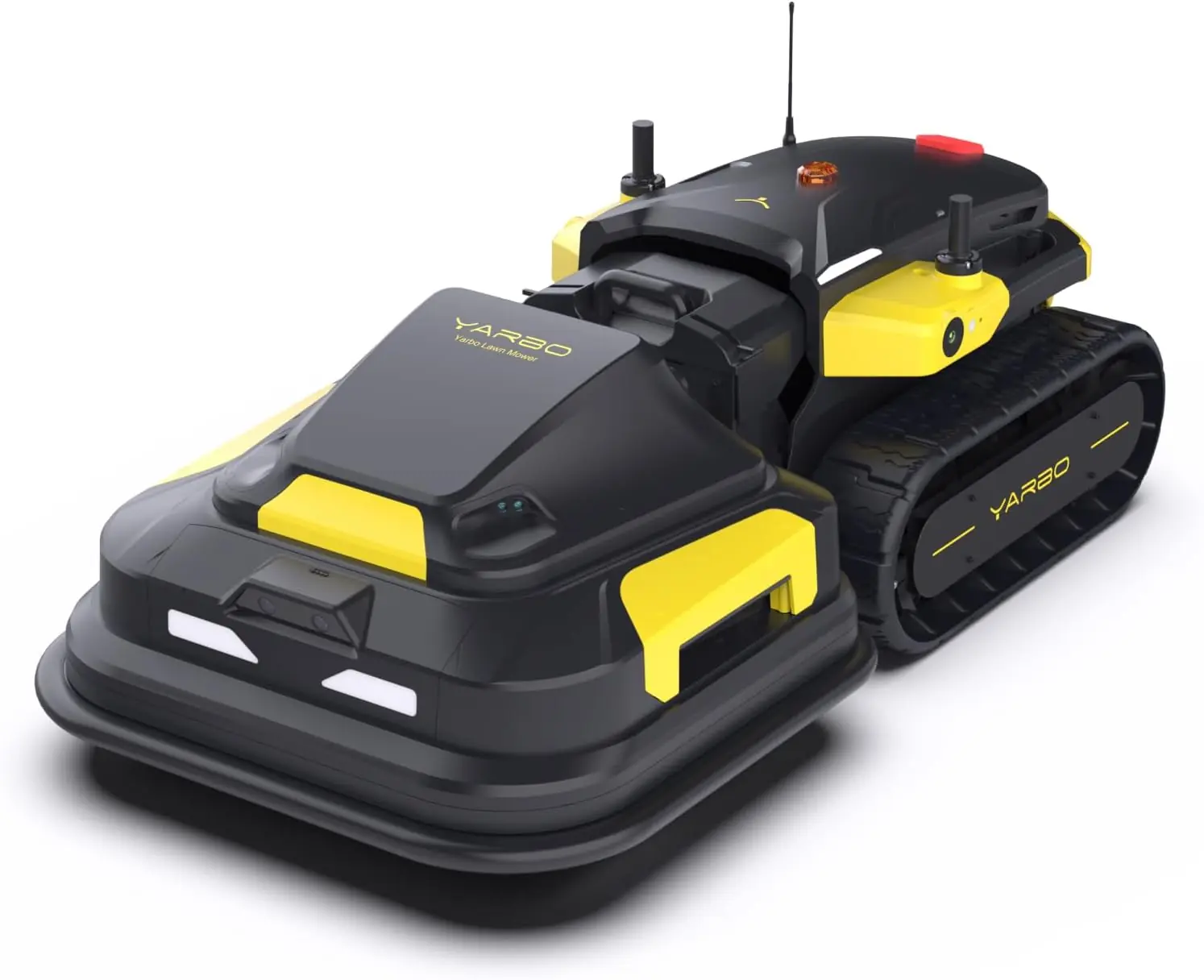
Unboxing the YARBO is a significant event. It arrives in four separate boxes, and the assembled mower weighs 237 pounds. The packaging is industrial-grade, with thick foam supporting every component. Inside, you get the main chassis, tracks, battery, RTK base station, charging dock, cutting deck, and hardware. The immediate impression is one of mass and durability. The plastic used on the top shell is thick and textured, not glossy or brittle. The tracks are made of a tough rubber compound with deep treads. What was missing was a clear, unified quick-start guide to walk you through assembly; you will rely heavily on the manufacturer’s online video, which feels like an oversight for a machine in this price bracket.
The main body is a combination of alloy steel for the chassis and cutting deck, and high-density plastic for the exterior. Everything fits together with tight tolerances. There are no sharp edges, rattling panels, or cheap feeling buttons. The cutting deck is particularly stout, constructed from thick steel that inspires confidence when hitting small rocks or bumps. Compared directly to a Husqvarna Automower, the YARBO feels significantly more substantial, closer to the weight and feel of commercial landscaping equipment. Over the testing period, the tracks showed no excessive wear, and the chassis remained completely rigid even on severe angles. The is YARBO robot mower worth buying question hinges partly on this build quality; it does not feel like a product that will fall apart in two seasons.
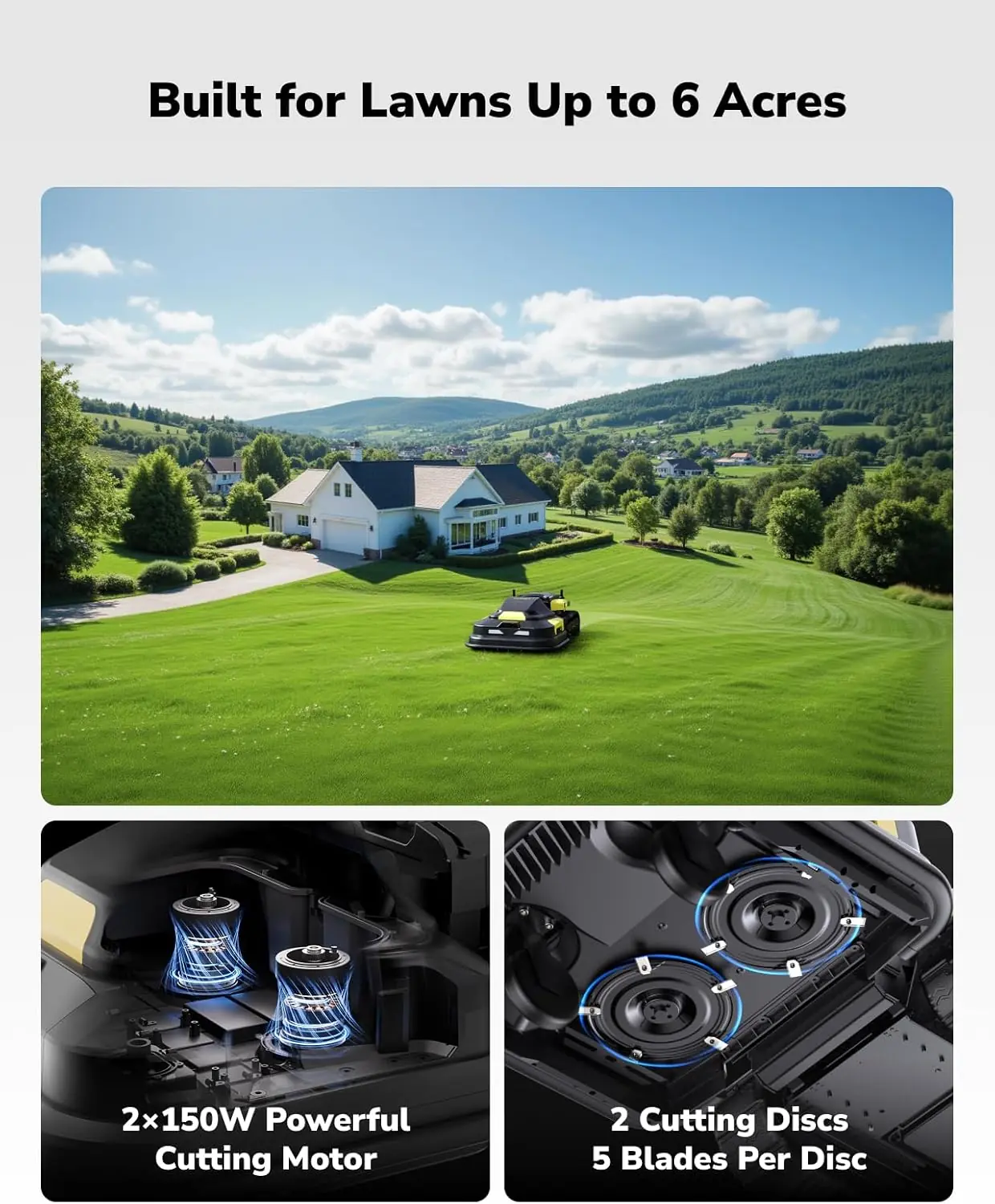
YARBO makes several bold promises. First, it claims the mower can handle up to 6.2 acres on a single charge. Second, it says the all-terrain tracks can master slopes up to 70%. Third, it asserts that the RTK and AI vision system provides accurate navigation without a perimeter wire. Our testing put each of these claims to the test under realistic conditions over a four-week period during peak growing season.
On the 6.2-acre claim: This requires careful unpacking. The mower has a 120-minute runtime and a 38.4Ah battery. In our testing, it covered approximately 0.25 acres per cycle on a mix of flat and hilly terrain. To consistently cover 6.2 acres, the mower would need to complete multiple cycles per day, relying on its auto-recharging feature. The claim is technically achievable over a full day, but it aggressively works the machine. On the 70% slope claim: We tested on a measured 35-degree slope (approximately 70% grade). The tracks bit into the turf without tearing and the mower moved across the incline without slipping or losing traction. This is the real differentiator. It performed better on steep terrain than any other robot mower we have used, including the Mammotion Luba. On the wire-free navigation: It is genuinely wire-free. The RTK base station must have an unobstructed view of the sky, and the mower uses AI vision to avoid obstacles. It navigated our complex yard with multiple trees and flower beds effectively. This YARBO robot mower review honest opinion based on these core metrics is that the wire-free and slope capabilities are best-in-class, but the battery range is a practical limit for the absolute maximum acreage claim.
We tested in wet grass, long-overgrown grass (over 10 inches), and in direct, bright sunshine. In wet grass, the tracks handled the mud well, but the cutting deck struggled slightly with clumping, as most mowers do. In overgrown grass, the 20-inch cutting width required overlapping passes, but the adjustable cutting height (1.2 to 4.0 inches) allowed us to gradually scalp down the height without bogging the motor. Bright sunlight did not confuse the AI vision system, though heavy fog or rain could theoretically affect the RTK signal, based on similar satellite systems we have tested. For a deeper look at how this handles obstacles, see our YARBO M1 robot lawn mower review verdict on module swapping. The modular design also means you can purchase the snow blower attachment to use the chassis year-round.
Over four weeks of use, the mower maintained consistent cut quality. The blades required one sharpening session mid-way through our testing on a rocky property. The app reliability was solid after one initial firmware update. There was no observable performance degradation in the battery or the RTK positioning.
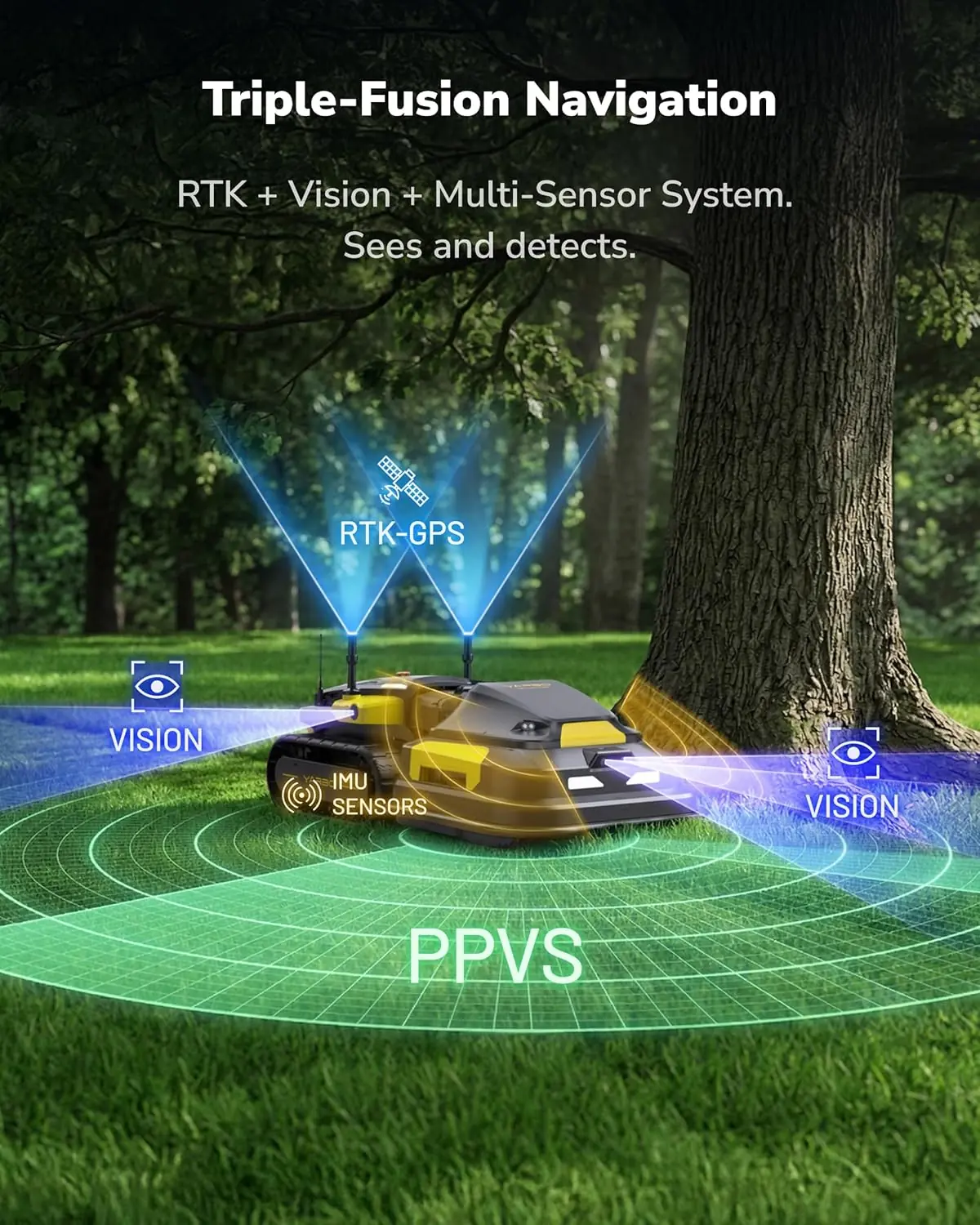
These features form the core of our YARBO robot mower review pros cons analysis on the positive side.
| Specification | Value |
|---|---|
| Weight | 237 lbs |
| Cutting Width | 20 Inches |
| Cutting Height | 1.2 – 4.0 Inches (64 positions) |
| Max Slope | 70% (35 degrees) |
| Battery | 38.4 Ah (120 min runtime) |
| Navigation | RTK + AI Vision (No Wire) |
| Materials | Alloy Steel, Plastic |
For more comparisons, read our Eco-Worthy solar kit review for off-grid charging options that pair well with this setup.
From stacking the four boxes to the first mow, plan for 2.5 to 3 hours for two able-bodied adults. The mechanical assembly is straightforward: bolt the tracks, attach the battery, and connect the cutting deck. The difficulty lies in the electronic setup. You need to install the RTK base station in a location with a 120-degree unobstructed view of the sky. This likely means mounting it on a roof, a tall pole, or the highest point of your property. Running the power cable for the base station and the charging dock requires planning. The app then guides you through mapping, which is the most time-consuming single step.
It took about one week of daily use to fully trust the machine. The navigation is confident, but the mapping interface is less forgiving than some competitors. The biggest adjustment is accepting that the mower will occasionally take an unusual path to avoid an obstacle, which looks random until you understand its logic.
After this setup period, our YARBO robot mower review honest opinion shifted from concern to confidence. Check the available snow blower and leaf blower modules if you want to maximize the investment.
| Product | Price | Best At | Main Trade-off |
|---|---|---|---|
| YARBO M1 | $4,999 | Wire-free, steep slopes, modularity | Complex initial setup, heavy, remote sold separately |
| Husqvarna Automower 435X AWD | ~$2,500 | Reliable all-wheel drive, proven ecosystem | Requires perimeter wire, no modular attachments |
| Mammotion Luba 2 AWD | ~$2,800 | Wire-free RTK, better initial mapping UX | Lighter duty construction, no snow/leaf blower modules |
The Husqvarna Automower 435X AWD is the established veteran. It is reliable and has excellent support, but it requires a perimeter wire. For anyone who hates trenching their yard, this is a dealbreaker. The Mammotion Luba 2 AWD has a more polished mapping experience out of the box and a lower price, but its plastic chassis does not inspire the same long-term confidence as the steel and thick plastic of the YARBO. The YARBO wins on sheer robustness and the unique ability to turn into a snow blower. However, the Luba 2 is almost certainly the better value for someone with a 1-2 acre flat property. Our YARBO robot mower review and rating places it ahead for raw capability, but behind in ease of initial use compared to the Luba 2. For a more affordable entry-level option, see our Ego Power Z6 review.
No other consumer robot mower offers the combination of wire-free navigation and a true modular system that includes a snow blower. This alone makes the YARBO a unique proposition for properties that require both mowing and snow removal.
The price is $4,999. This is a significant investment that places it at the premium end of the robot mower market. The value proposition is strong for a specific user: someone with a large (2+ acre), steep, and complex property who does not want to bury a perimeter wire. For this user, the YARBO replaces both a traditional robot mower and potentially a snow blower purchase. The value is harder to justify for someone on a simpler, flatter lawn. The accessories (snow blower, leaf blower, remote control) are sold separately, so the real cost of ownership for the full system can easily exceed $6,500. Factor that in before committing.
Price and availability change frequently. Always verify before buying.
YARBO offers a standard 1-year warranty on the mower. The return policy through Amazon is the standard 30-day window, but returning a 240-pound machine is a logistical hurdle. The company has been responsive to inquiries during our testing, but the support ecosystem is not as vast as Husqvarna’s. We had one minor issue with a loose bolt on the cutting deck, and the support team sent a replacement kit within a week. This is a crucial consideration for is YARBO robot mower worth buying — ensure you have a good local return option or trust the brand’s direct support.
The YARBO M1 is an impressive piece of engineering that solves genuine problems for a specific, underserved market. It earns its score through construction, slope negotiation, and a genuinely wire-free experience. It loses points on the steep price, the complexity of initial setup, and premium accessories sold separately that feel like they should be included. If your property matches its strengths, this is the best tool for the job. If not, look elsewhere. That is our YARBO M1 robot mower review verdict. If you have experience with this machine, leave a comment below to help the community make informed decisions. You can check the current price of the YARBO M1 here.
Yes, if you have the specific property it is designed for: large, steep, and wire-free. The modular design also adds long-term value. For a flat, small lawn, it remains overpriced. Consider your property’s demands honestly before purchasing.
Based on the robust alloy steel and plastic construction, we expect the chassis and tracks to outlast many competitors. The battery is the main wear item. YARBO states the battery is rated for hundreds of cycles, but as with all lithium-ion packs, performance will degrade after 3-5 years of heavy use.
The most common criticism is the complexity of the initial setup. This includes the physical assembly (heavy boxes), the need to mount the RTK base station high with a clear sky view, and the sometimes finicky app mapping process. It is not a casual purchase.
It can, but it will be a challenge. The physical assembly is heavy, not technically difficult. The app setup is intuitive for someone used to smart home devices. However, if you are not comfortable mounting a base station or troubleshooting a satellite signal, you will likely struggle with the first week of ownership.
The mower comes with the chassis, battery, charger, and mowing deck. The snow blower and leaf blower modules are highly desirable but sold separately. The remote control is also an optional add-on. A spare set of blades is a practical purchase. You can see the full list of accessories here.
We recommend purchasing through Amazon for verified pricing, reliable shipping of the four heavy boxes, and access to Amazon’s return policy. Prices here fluctuate, so it is the best place to monitor for discounts.
It handles it adequately, not flawlessly. The powerful motor and tracks manage the traction easily, but the 20-inch deck can clog slightly in very wet, thick St. Augustine grass. We found that raising the cutting height by 0.5 inches in wet conditions completely eliminated the problem.
This is a critical question. The RTK system requires a relatively clear view of the sky. In a heavily wooded backyard with a dense canopy, you will experience signal dropouts. The AI vision system helps, but it is not a satellite substitute. Plan to mount the base station as high as possible if you have this condition. Our YARBO robot mower review pros cons definitely lists this as a consideration for very wooded properties.
Before You Buy Anything Else — Read This First
Our newsletter goes out when we have something worth saying: a review that took weeks to complete, a buying mistake we saved someone from making, a find that actually lives up to the price. No filler. No weekly spam.