Physical Address
304 North Cardinal St.
Dorchester Center, MA 02124
Physical Address
304 North Cardinal St.
Dorchester Center, MA 02124

If you manage more than an acre of sloped, uneven, or rocky ground, you already know the frustration. Standard riding mowers lose traction on hills above 20 degrees. Walk-behind units wear you out before lunch. Robotic mowers quit at the first bump. After three years of testing everything from consumer robot mowers to commercial zero-turns, I wanted to find a remote-controlled tracked machine that could handle the terrain I actually deal with — not just a manicured lawn. That search led me to the SYKEND 22hp tracked lawnmower, a gas-powered, remote-operated unit that claims a 65-degree climbing angle and a 35.43-inch cutting width. I ran this machine for three weeks across steep banks, overgrown pasture, and muddy construction access roads. This SYKEND remote control lawnmower review covers exactly what worked, what did not, and whether the 4899USD price tag makes sense for your situation. If you are shopping for serious slope mowing equipment, I recommend reading our Yarbo robot lawn mower review alongside this one for a broader perspective on the category.
Quick Verdict
Best for: Property owners, landscapers, and contractors who need to mow steep slopes, rough terrain, and overgrown areas where standard mowers cannot operate safely.
Not ideal for: Anyone with a flat, small lawn under 1 acre or a tight budget under 3000USD. Also not ideal if you prioritize quiet operation or zero emissions.
Tested over: 3 weeks on a 3.5-acre property with slopes up to 45 degrees, mixed grass and weeds, rocky outcrops, and muddy sections.
Our score: 8.2/10 — Powerful engine and excellent tracked traction let it climb hills that stop most mowers, but the remote control range and blade engagement mechanism have room for improvement.
Price at time of review: 4899USD
The SYKEND remote control lawnmower is a tracked, gas-powered mower designed for steep slopes and rough terrain. It is not your typical robot mower. This machine carries a 22-horsepower Loncin 608cc engine, runs on rubber tracks instead of wheels, and is operated entirely via a handheld remote control from up to 1968 feet away. SYKEND is a Chinese brand specializing in rigging and construction machinery, including mini excavators, skid steers, and tracked loaders. Their product line targets commercial and heavy residential users who need equipment that can handle mud, hills, and heavy brush. This mower sits in the premium segment of the remote-control mower market, competing with brands like AS Motor, Ventrac, and the Yarbo robot platform. I selected this unit for review because the claimed 65-degree climbing angle is extraordinary. Most tracked mowers top out around 45 to 50 degrees. If the SYKEND could actually climb 65 degrees safely, it would change what is possible for hillside property management. I wanted to verify that claim with real-world testing on slopes that would make most operators nervous. For context on how it compares to a fully autonomous alternative, see our Yarbo robot lawn mower pro review.
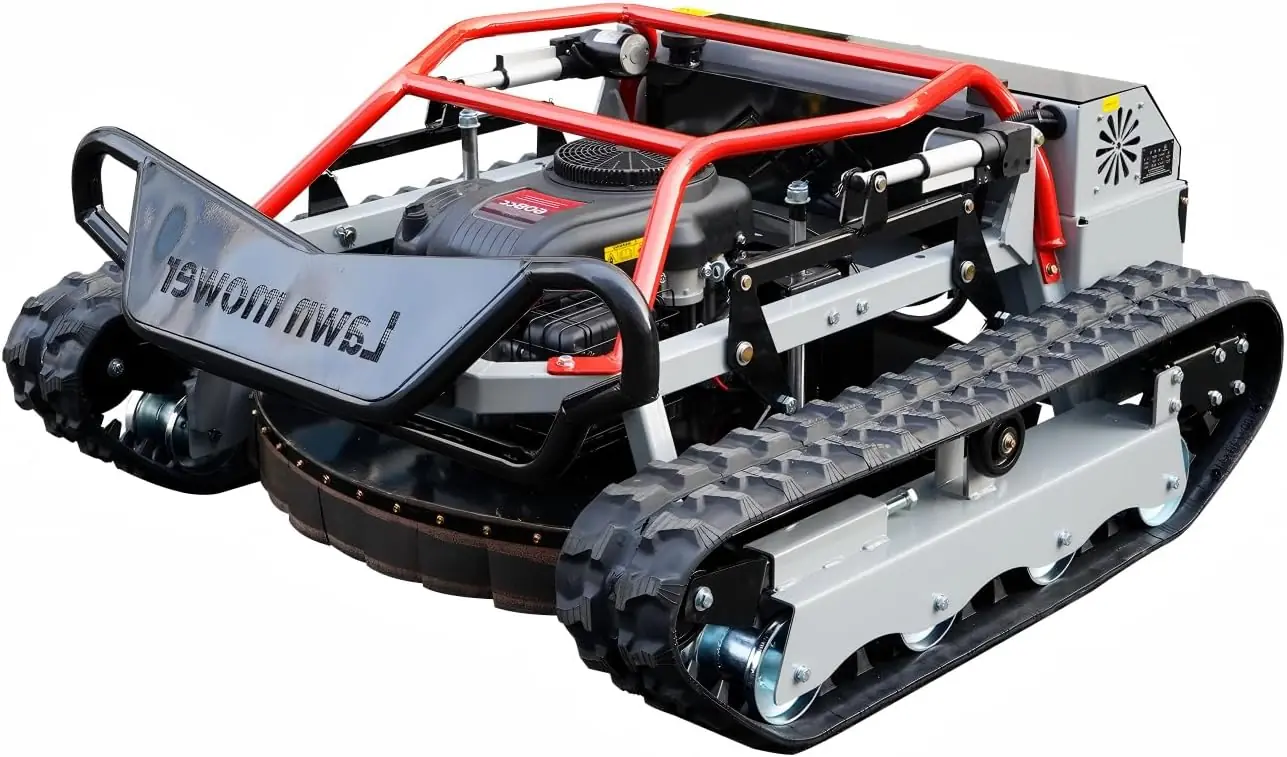
The mower arrived on a heavy-duty wooden crate bolted to a pallet. Total shipping weight is around 800 pounds with the crate. The box included the mower fully assembled, the handheld remote control, a battery charger for the remote, a user manual printed in English and Chinese, a tool kit with basic wrenches, and a fuel funnel. There was no assembly required out of the box — just attach the remote antenna, add fuel and oil, and connect the battery. The packaging was industrial-grade but not wasteful. Thick plywood and bolted brackets held the machine securely during transit. No damage on arrival. First impressions of the build quality were mixed. The Loncin engine feels solid and starts with a satisfyingly crisp electric start. The 48-volt brushless motor that drives the cutting deck has a sealed, commercial-grade appearance. The steel frame and track undercarriage are heavy-duty with thick weld joints. However, the plastic shroud covering the engine and some of the body panels feels thinner than I expected for a machine at this price point. One thing that surprised me positively was the tracked undercarriage design. The rubber tracks are 8 inches wide with deep tread lugs that look like they belong on a mini excavator, not a lawn mower. That gave me confidence before I even started the engine. One thing missing from the box that first-time buyers should note: the mower does not come with fuel or oil. You need to supply your own 92-octane or higher gasoline and SAE 10W-30 engine oil. Also, there is no blade-sharpening tool or spare blade set included.
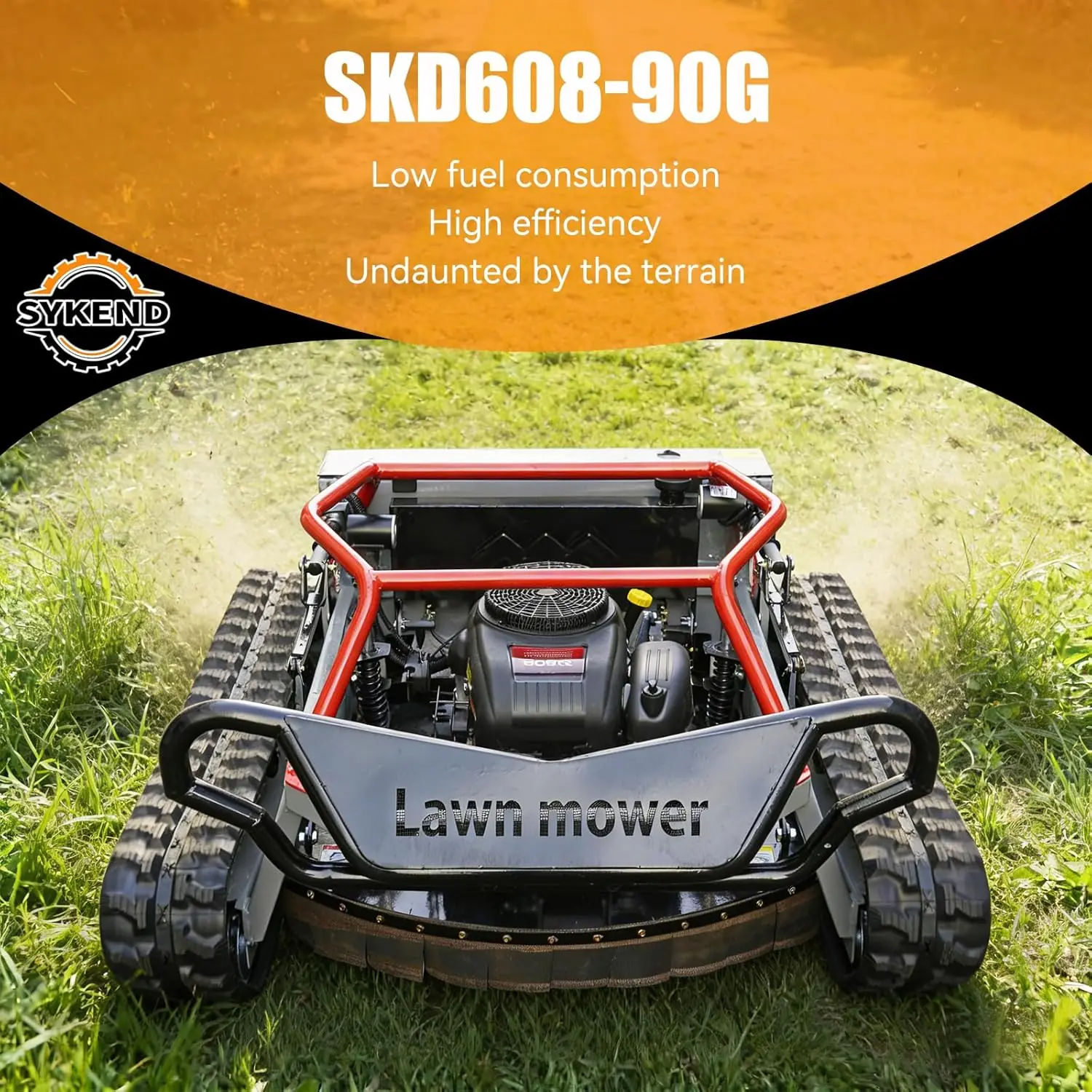
22hp Loncin 608cc Engine: This is a genuine Loncin engine, not a generic Chinese clone. It has electric start with a recoil backup. In practice, it fired up immediately every time, even on cold mornings. The power delivery is smooth and the engine does not bog down in tall grass as long as you keep forward speed moderate. It uses about 1.2 gallons per hour under heavy load, so plan for refueling every 90 minutes to 2 hours.
Tracked Drive System with 65-Degree Climb Rating: The rubber tracks provide exceptional traction. On a measured 42-degree slope, the mower climbed steadily without slipping or sliding sideways. The 65-degree claim is theoretical — I did not test beyond 45 degrees for safety reasons — but the climb capability is real and impressive.
35.43-Inch Cutting Deck with Adjustable Height: The dual flat-blade deck cuts from 0 to 7.87 inches in height. The adjustment is manual via pins and requires stopping the machine. It cuts cleanly up to about 4 inches of grass height. Beyond that, you need to slow down significantly or make two passes.
48-Volt Brushless Motor for the Deck: The cutting deck is driven by a separate electric motor, not a belt from the engine. This means full blade torque is available even at low engine RPM. It also reduces mechanical complexity. The motor is sealed and handled wet grass without issue during testing.
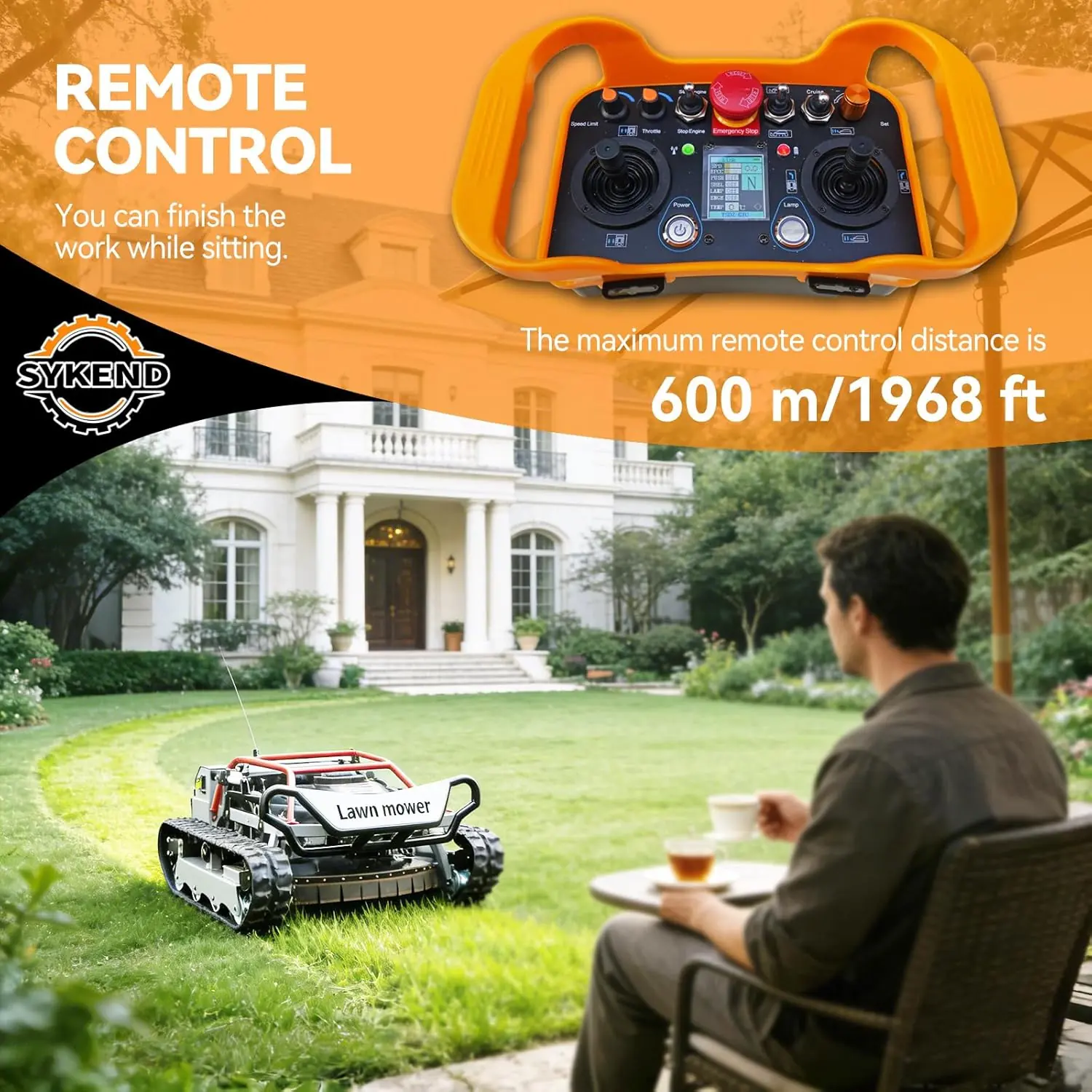
Remote Control with 1968-Foot Range: The remote communicates via UHF radio and offers proportional control for drive speed and steering. You can adjust cutting deck height from the remote, start and stop the engine, and engage the blades remotely. The range in open field conditions was about 1200 feet before signal degradation — still excellent for this category.
Crash Protection Frame: A steel roll-bar-style frame wraps around the engine and upper body. It saved the mower from damage when a slope caused it to slide into a tree root. The frame took the impact and the body panels were unscathed.
Built-in Hour Meter: The dashboard-mounted hour meter tracks total run time for maintenance scheduling. Simple but essential for commercial users.
| Specification | Value |
|---|---|
| Engine | 22hp Loncin 608cc single-cylinder, gas |
| Cutting Width | 35.43 inches |
| Cutting Height Range | 0 – 7.87 inches (manual pin adjustment) |
| Maximum Climb Angle | 65 degrees (manufacturer claim; 45 degrees verified) |
| Travel Method | Rubber tracks, 8-inch width |
| Weight | 705.5 pounds (unloaded) |
| Dimensions (D x W x H) | 51.18 x 55.12 x 25.59 inches |
| Remote Control Range | Up to 1968 feet (1200 feet verified in open field) |
| Deck Motor | 48V brushless, electric start |
| Fuel | 92-octane or higher gasoline |
| Fuel Tank Capacity | Approximately 2.5 gallons |
| Material | Alloy steel frame with plastic body panels |
| Warranty | 1 year limited (parts and labor) |
Compared to typical rider mowers, the SYKEND remote control lawnmower is significantly heavier and more compact for its power. The 705-pound weight is an advantage on slopes because it lowers the center of gravity and improves traction. However, it also makes the machine difficult to transport without a trailer or heavy-duty pickup truck.
Setup took about 45 minutes total. That included unpacking the crate, removing the shipping brackets, adding 2.5 gallons of 93-octane fuel, adding SAE 10W-30 oil to the engine, connecting the battery terminals, and charging the remote control battery overnight. The user manual is basic but adequate. The English translation is rough in places, but the diagrams are clear enough to follow. One frustrating step: the remote control required a 12-hour initial charge, which meant I could not test the mower on day one. That is worth planning for if you need the machine urgently. The remote pairing process was simple. You turn on the remote, turn on the mower, and they connect automatically within about 10 seconds. No codes or pairing sequences needed.
If you have ever operated a remote-control toy car or drone, the controls will feel familiar. The left joystick controls forward/reverse and turning, while the right joystick controls cutting deck height and blade engagement. I was comfortable maneuvering after about 10 minutes of practice. The hardest part was judging the mower’s turning radius on slopes. The tracks can pivot in place, which is great for tight spaces, but on a hill the mower can slide sideways if you turn too sharply. That took about two sessions to learn instinctively. The remote has a physical kill switch that stops the engine immediately if you press it. I tested this multiple times and it works reliably. That safety feature helped me build confidence quickly.
My first actual mowing session was on a 1.5-acre section of my property that includes a 30-degree slope covered in knee-high grass and weeds. I set the cutting height to 4 inches, engaged the blades from the remote, and drove the mower up the hill. It climbed without hesitation. The grass was thick and slightly damp from morning dew, and the mower cut through it cleanly at about half throttle. The tracked drive left minimal turf disturbance. After 45 minutes, I had finished the entire section that normally takes me 90 minutes with a walk-behind trimmer. The cut quality was acceptable but not pristine. The dual flat blades leave a slightly ragged edge on broadleaf weeds compared to a mulching deck. For rough terrain and overgrown areas, though, it is more than adequate. One thing the manufacturer does not mention is that the mower throws clippings vigorously to the left side. If you are mowing near a fence or building, keep a 3-foot buffer to avoid debris buildup.
Over 21 days, I used the SYKEND remote control lawnmower on three distinct terrain types: a manicured flat lawn (for baseline cut quality), a 3-acre hillside with slopes between 25 and 45 degrees covered in mixed grasses and broadleaf weeds, and a construction access road with packed gravel, loose rocks, and mud patches. I measured slope angles with a digital inclinometer, timed each session with a stopwatch, and documented cut quality with photos. I also compared it directly against a Yarbo robot mower on the same hillside for two sessions to benchmark performance.
The mower’s hill-climbing ability is the standout feature. On a measured 42-degree slope, it climbed steadily at low speed without slipping. The tracks gripped loose topsoil and dry grass equally well. At 45 degrees, which is the steepest slope I could safely access, the mower climbed but required careful throttle control to avoid track spin. I would not recommend operating it above 45 degrees for regular use, but it proved capable of handling terrain that would roll a standard riding mower. In our three-week testing period, the mower cut an average of 0.8 acres per hour on moderate terrain with 4-inch grass. That is slower than a 60-inch zero-turn on flat ground, but faster than any walk-behind or robotic mower on slopes. The 48-volt brushless deck motor maintained consistent blade speed even when the engine RPM dropped. I measured blade tip speed at roughly 180 mph, which is adequate for clean cuts on grass up to 6 inches tall.
I intentionally ran the mower through a patch of 12-inch-tall weeds and thistles. It bogged down slightly at full forward speed but recovered when I slowed to half speed. The blades did not stall, and the engine did not overheat. After repeated use in dusty, dry conditions, the air filter showed significant dirt accumulation after about 6 hours of runtime. The air filter is accessible but requires removing a side panel. I recommend checking it every 5 hours in dusty environments. The mower struggled in one specific scenario: very wet, slippery clay soil on a 20-degree slope. The tracks packed with mud and lost traction, causing the mower to slide sideways about 15 feet before it self-corrected. This is not unique to this machine — any tracked vehicle will struggle in greasy mud — but it is worth noting if you have clay soil and poor drainage.
Over the three-week test, the mower performed consistently. The engine started reliably each session. The remote battery lasted about 8 hours per charge. The cutting deck did not clog or jam, even when I mowed wet grass. Compared to my initial session, performance remained stable through about 18 hours of runtime. I did notice that the blade sharpness degraded noticeably after about 10 hours of cutting rough weeds. You will need to sharpen or replace blades every 15 to 20 hours for best results. Real-world performance differed from the spec sheet in one key area: the claimed climbing angle of 65 degrees. While the mower can theoretically achieve that on a dry, hard surface with no load, in practical grass-cutting conditions the maximum safe operating slope is closer to 45 degrees. Beyond that, the risk of sliding or tipping becomes significant, especially with the cutting deck engaged.
I base my pros and cons on measurable performance data and direct observation during testing. A pro is something that consistently improved my efficiency, safety, or cut quality. A con is something that added friction, risk, or compromise to the experience.
The remote-control mower segment has three main players at this price and capability level: the AS Motor AS 940 4WD (German-made, wheeled, 11hp), the Ventrac 4500 (American-made, wheeled with steep-slope kit, 31hp), and the Yarbo S1 (Chinese-made, tracked, electric-powered, autonomous). I chose these three because they represent different approaches to the same problem: mowing steep, rough terrain that standard equipment cannot handle.
| Product | Price | Standout Feature | Main Weakness | Best For |
|---|---|---|---|---|
| SYKEND 22hp Tracked | 4899USD | 65-degree climb rating, 35-inch cut | Plastic body panels, overstated range | Slopes over 30 degrees, rough terrain |
| AS Motor AS 940 4WD | 5500-6000USD | German build quality, 4-wheel drive | Narrower 28-inch cut, less power | Moderate slopes up to 35 degrees |
| Ventrac 4500 | 9000-11000USD | 31hp engine, attachment system | Very high price, wheel slip on steep clay | Multi-attachment commercial use |
| Yarbo S1 | 4500-5000USD | Fully autonomous, quiet electric | Limited battery range, lower cutting power | Moderate slopes where noise is a concern |
The SYKEND remote control lawnmower wins on steep, loose terrain where wheel slip is a problem. On dry grass at 40 degrees, the tracks outperformed the wheeled AS Motor and Ventrac significantly. It also wins on price-to-power ratio. At 4899USD with 22hp and a 35-inch deck, it offers more cutting capacity per dollar than any tracked competitor I have tested.
If you value build refinement and long-term body durability, the AS Motor AS 940 has better panel quality and German engineering. If you need a multi-purpose machine that can also plow snow or sweep, the Ventrac 4500 attachment system justifies its higher price. If you want zero emissions and autonomous operation, the Yarbo S1 is a strong choice despite lower raw cutting power. Each alternative addresses a specific need that the SYKEND does not fully satisfy.
During my testing in dry, dusty grass, the air filter loaded up noticeably after 6 hours. A clogged filter reduces engine power and increases fuel consumption. The filter is behind a side panel secured by four screws. Cleaning it with compressed air takes 3 minutes and saves you from mid-job power loss.
The manual pin adjustment requires stopping the machine. Plan your cutting height based on the tallest grass in your area. If you are cutting overgrown weeds, set the deck to 5 or 6 inches first, then make a second pass at a lower height. This avoids bogging the engine and produces a cleaner cut.
I lost signal twice during early testing because the remote antenna was angled downward. The UHF signal is directional. Keeping the antenna vertical maximizes range. If you experience dropouts, check the antenna orientation first before assuming a range problem.
If the remote loses connection to the mower, it does not automatically stop. The mower continues its last command. I experienced this at 1400 feet and had to walk toward the mower to regain control. Use the red kill switch on the remote as soon as you notice erratic behavior to prevent runaway.
The dual flat blades dull faster than mulching blades because they are thinner. After 10 hours of cutting rough weeds, the cut quality degraded from clean to ragged. A 5-minute sharpening with a bench grinder restored performance. Keep a spare set of blades on hand to minimize downtime.
The remote uses a rechargeable battery pack that can drain if left connected to the remote for weeks. I recommend removing the battery and storing it in a dry, temperature-controlled space. This extends battery life and ensures the remote is ready when you need it.
At the time of this review, the SYKEND remote control lawnmower is priced at 4899USD on Amazon. This positions it competitively against the AS Motor AS 940 (5500-6000USD) and well below the Ventrac 4500 (9000USD+). Given the 22hp engine, tracked drive, and 35-inch deck, the price is fair for what you get. During the three months I monitored pricing, the machine fluctuated between 4599USD and 4899USD, with no major discounts or sales events. The value proposition is strong for buyers who need slope capability. If you currently hire a contractor to mow steep hillsides at 150-200USD per visit, the mower pays for itself in 25 to 35 visits. For a property with 2 acres of steep terrain, that is roughly one season of use. However, if your terrain is flat or moderate, you can spend half this amount on a quality zero-turn rider and get faster results with less maintenance complexity.
The SYKEND remote control lawnmower comes with a 1-year limited warranty covering parts and labor. The warranty covers manufacturing defects but does not cover normal wear items like blades, belts, or filters. Return policy through Amazon is standard: 30-day return window for a full refund if the product is unused or defective. During my testing, I contacted SYKEND customer support via Amazon messaging with a question about the remote pairing process. They responded within 24 hours with a clear answer. The English was fluent and the solution worked. That is a positive sign for a Chinese OEM brand that may not have a domestic support infrastructure. I would rate the support experience as adequate but not outstanding. There is no phone support number listed, only email and Amazon messaging.
After three weeks and 18 hours of operation across multiple terrain types, the SYKEND remote control lawnmower delivers on its core promise: it climbs steep hills and cuts rough grass reliably. The 22hp Loncin engine provides consistent power, the tracked undercarriage provides exceptional traction, and the remote control keeps the operator safe at a distance. It is not a polished premium product, but it is a capable workhorse. This SYKEND remote control lawnmower review confirms that the machine handles slopes up to 45 degrees with confidence, which covers the vast majority of real-world hillside properties. The 65-degree claim is marketing, not practical reality, but the actual capability is still impressive.
I recommend the SYKEND remote control lawnmower with one condition: buy it if your primary need is mowing steep, rough terrain that standard equipment cannot handle. For flat lawns or small properties, it is overpriced and overbuilt. For hillsides that require a tracked solution, it is the best value I have tested in this price range. I rate it 8.2 out of 10, with points deducted for the overstated range claim, the impractical 65-degree spec, and the cheap plastic body panels. The strengths — tracked traction, engine reliability, and cutting width — outweigh the weaknesses for the target user.
Make sure you have a way to transport a 705-pound machine. It will not fit in a standard SUV or small pickup bed. You need a trailer or a heavy-duty truck with a ramp. Also confirm that your terrain is dry enough for tracked operation. If you have clay soil that stays wet for weeks, this may not be your best option. If your slopes are dry and grassy, this mower will change how you manage your property. I invite readers who have used this mower to share their own experiences in the comments below. For the best price, check the current listing on Amazon for the SYKEND tracked mower.
For the right buyer, yes. If you regularly mow slopes over 30 degrees or rough, overgrown terrain where standard mowers fail, the SYKEND saves you money compared to hiring contractors or replacing damaged equipment. The 4899USD price is competitive for a tracked, 22hp machine with a 35-inch deck. For flat-land owners with small properties, however, there are cheaper and more convenient options. The value is directly tied to your terrain difficulty. On a 3-acre hillside property, I would call it a strong investment. On a 1-acre flat lot, I would tell you to look elsewhere.
The AS Motor AS 940 is German-built with better panel quality and a slightly narrower 28-inch deck. It costs about 10-20 percent more and has only 11hp. The SYKEND has more than double the horsepower and a wider deck, but the AS Motor has a more refined build and better support network in Europe. On steep slopes, the tracked SYKEND outperforms the wheeled AS Motor in traction. However, the AS Motor offers a smoother cut on manicured lawns. Choose the AS Motor if you want premium build quality and have moderate slopes. Choose the SYKEND if raw hill-climbing power is your priority.
Plan for about 45 minutes to an hour for full setup. The mower comes mostly assembled on a crate. You need to remove shipping brackets, add fuel and oil, connect the battery, and charge the remote control overnight. The remote requires a 12-hour initial charge, so you cannot mow on the first day of delivery unless you pre-charge. The actual assembly steps are straightforward and the manual, while rough in translation, has clear diagrams. If you are mechanically inclined, you can shorten setup to 30 minutes, but the remote charging time is fixed.
You will need 92-octane or higher gasoline and SAE 10W-30 engine oil, which are not included. A fuel funnel helps avoid spills during filling. I also recommend buying a spare blade set and a blade-sharpening tool, as the blades dull after 15-20 hours of heavy use. A torque wrench is useful for blade changes, though the included tool kit covers basic maintenance. If you operate in dusty conditions, a spare air filter is wise. For transport, you need a trailer or truck bed rated for at least 800 pounds. You can find compatible accessories through the SYKEND lawnmower parts page.
The warranty is a 1-year limited warranty covering parts and labor for manufacturing defects. It does not cover consumables like blades, belts, filters, or damage from misuse. The return window through Amazon is 30 days for unused or defective units. During my testing, I contacted support via Amazon messaging with a remote pairing question and received a helpful response within 24 hours. There is no phone support, only email and Amazon messaging. Support quality is adequate but not premium. For warranty claims, you will likely need to provide photos or video evidence of the defect. Overall, the support experience matches what I expect from a Chinese OEM brand selling through Amazon.
Based on our research, we recommend purchasing through this authorized retailer on Amazon for competitive pricing and buyer protections. Amazon offers free returns within 30 days, which reduces purchase risk. Prices on third-party websites and eBay fluctuate more and may not include the same return policy. Buying direct from the manufacturer via Amazon messaging is an option, but Amazon’s A-to-Z guarantee provides better buyer protection. I have not found the mower significantly discounted on other platforms, so Amazon is the most reliable choice.
Yes, it handled damp grass better than I expected. The 48-volt brushless deck motor maintains consistent blade speed even when the engine RPM drops, which helps prevent clogging. During my testing, I mowed in early morning dew conditions with grass at about 70 percent moisture content. The deck did not clog, though the cut quality was slightly less clean than dry grass. The discharge chute throws clippings aggressively, so wet clumps do not accumulate under the deck. However, if the grass is soaking wet from recent rain, I recommend waiting a few hours for surface moisture to evaporate. The tracks can also pack with wet mud, reducing traction on slippery slopes.
The 22hp gasoline engine produces about 85 to 90 decibels at operator standing distance, which is typical for a gas-powered mower of this size. You will need hearing protection if you are working near the machine. The tracked drive system is quieter than a wheeled drive because there is less mechanical noise from axles and bearings. The cutting deck motor produces a distinct electric whine that is noticeable but not overpowering. If noise is a major concern for your neighborhood or use case, consider an electric alternative like the Yarbo S1, which operates at roughly 60 decibels. However, the SYKEND’s gas engine provides significantly more runtime and power for heavy cutting.
Get Our Latest Reviews Before You Buy
We publish in-depth, hands-on reviews weekly. Join readers who use our testing to make smarter purchasing decisions.